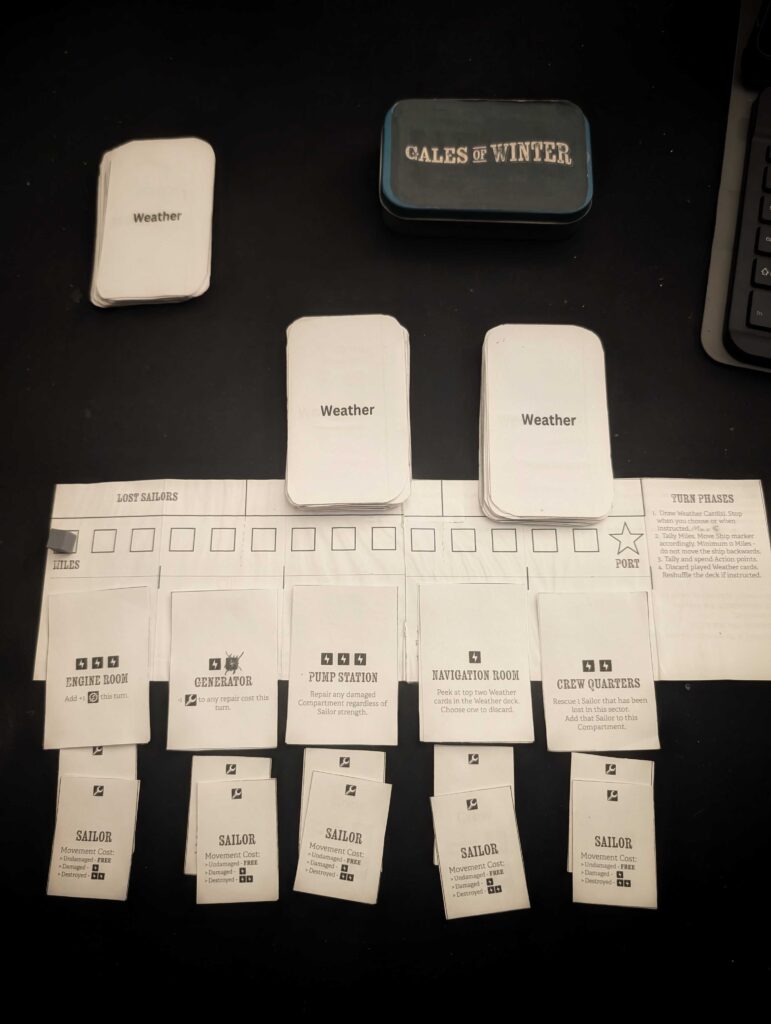
Gales of Winter fits in an Altoids tin. The whole game started there.
I came up with the idea on a business trip. I wanted to develop a small solo game that would let me iterate quickly and learn the full development process without spending years on a single project. I wanted something portable, and I happened to have an Altoids tin in my bag. That tin became the box. And from there, I added a second constraint: the game had to be playable on an airplane tray table.
Those two decisions, the tin and the tray table, shaped everything that followed.
The Constraint That Cut the Die
Early in development, Gales of Winter had a dice mechanic. At the start of each turn, you’d choose your speed, which acted as a multiplier for any damage taken that turn. Then the die doubled as a damage allocator. The roll determined which compartment took the hit.
The die was doing two jobs, and neither of them fit cleanly. The tin didn’t have room for it alongside the cards, and once I looked at the mechanic honestly, it felt tacked on. It didn’t match the rhythm of the rest of the game.
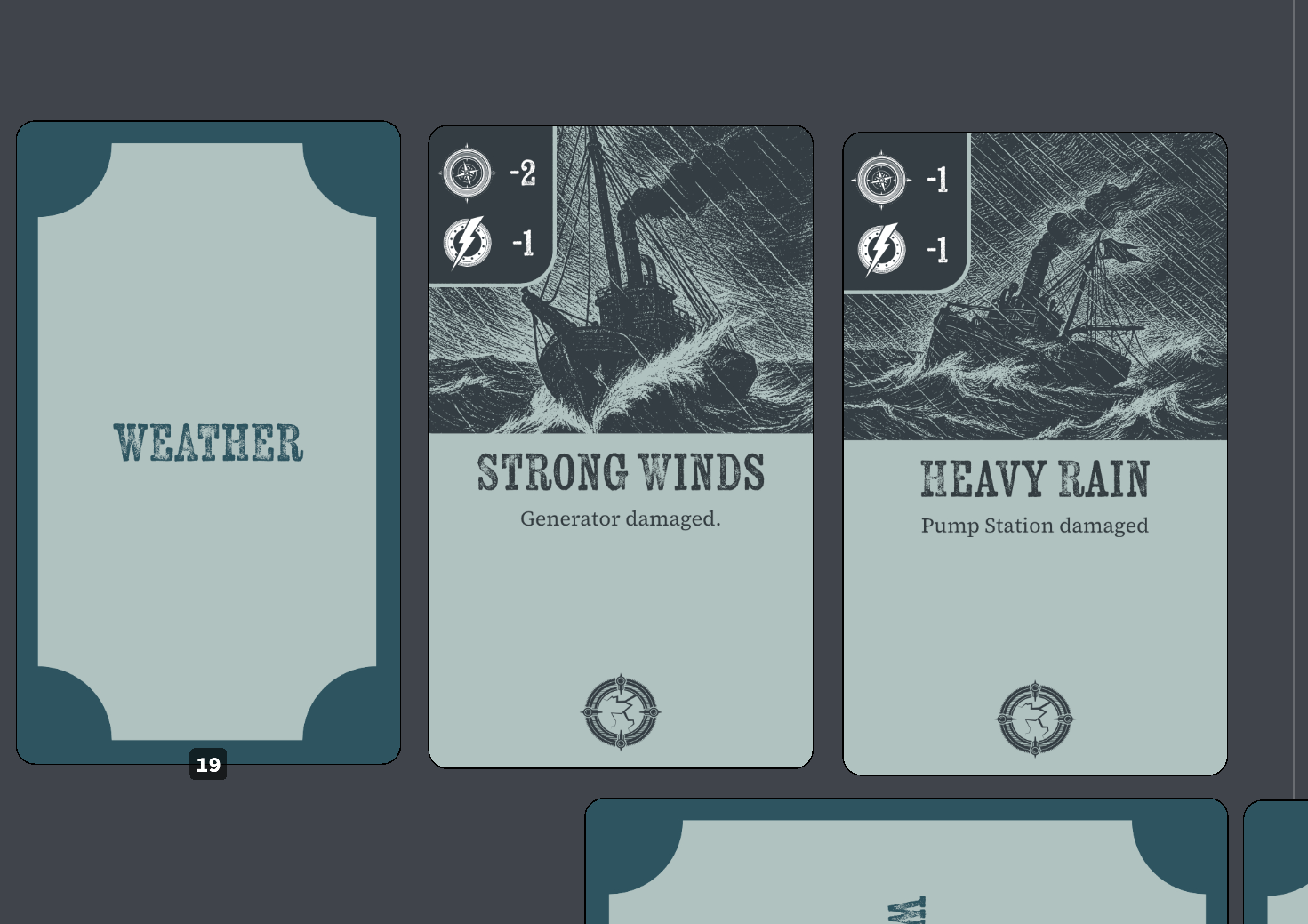
An early playtester suggested ditching the die entirely, and the solution clicked immediately. Both functions, speed and damage targeting, got folded into the Weather cards. Miles are now printed directly on the cards. Damage cards specify which compartment gets hit. No extra component, no context-switching for the player. The cards run the whole game.
It was one of those “why didn’t I see this earlier?” moments. The constraint said no room for this, and when I looked closer, the game was saying the same thing.
Building Up vs. Trimming Down
The tin shaped more than components. It shaped how I approach card count and variety. It’s easy to come up with Weather card ideas. The constraint forces you to keep the count limited. I set a target of 30 cards or fewer, partly for space and partly because the game is supposed to be quick. It doesn’t need a huge deck.
I started with the structural backbone: five Damage cards (one for each compartment), balanced with five minor Weather cards, then one really good card and one catastrophically bad card. I built out from there slowly, balancing necessity against variety.
There was nothing systematic about it. It was more about feel. I could playtest solo as much as I wanted, so I got a quick read on game balance early. I only added what the game needed. If a card didn’t earn its spot, it didn’t go in.
This is the opposite of how I designed my first game, Atomic Edge. With that one, I didn’t know any better. I added everything. Every idea, every mechanic, every component that sounded interesting. Most of my time since then has been spent cutting and scaling back.
Gales of Winter was a deliberate correction. Start with the minimum. Start with what’s functional. Only add when it’s been carefully considered and determined to be a genuine value add. I stopped throwing everything at a game and hoping it coheres. Now I build a skeleton first, then add only the muscle the skeleton needs.
The Tin Is the Philosophy
One of the values at Workhorse Game Studio is “Tight Over More.” Every mechanic earns its place, and we’d rather cut a good idea that doesn’t serve the whole than keep it in to impress. The Altoids tin is that principle made physical. The box itself won’t let you over-design.
But the real lesson goes beyond tins and small games. Starting points matter. If you start big, with lots of components, lots of mechanics, lots of scope, you’ll spend most of your time trimming. And it’s hard to cut things you’ve already built and gotten attached to. If you start small, you only add what proves it deserves to be there. The game tells you what it needs.
Your game doesn’t have to be small. But start with a working skeleton and gradually build up.
What’s Next
The next few weeks are focused on testing. There’s a game expo coming up, which should be a good opportunity to get Gales of Winter in front of fresh players. People who’ve never seen the game and will just react honestly. Fresh eyes catch things that familiar ones miss, and that’s exactly what the game needs right now.
Gales of Winter is a solo card game about navigating a damaged ship through the North Atlantic. It’s coming to Kickstarter in October 2026. Follow along at [Instagram/newsletter link].